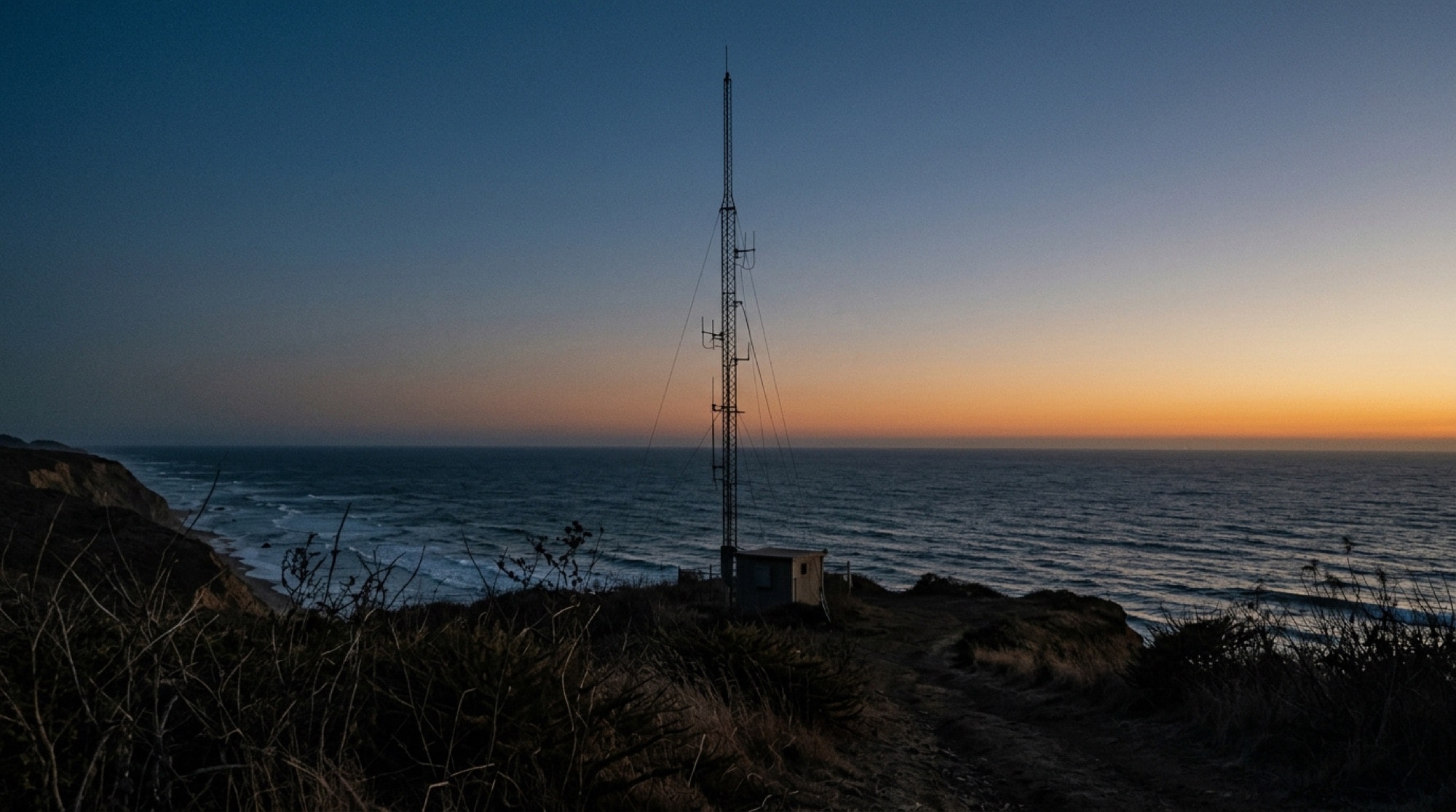
For a stretch of the early 2000s, West Coast anglers could watch a bite develop from a desk. Not on a webcam and not through anything the boats themselves published — through radio. The system was called Reel Time Reports, and it worked by putting receiving equipment on the coast where the fishing traffic was, listening, and typing what came over the air onto a message board as it happened.
The Mechanics
Sportfishing boats talk. Skippers on a coast this crowded run informal radio networks: who is on fish, what grade, what depth, which bait is working, where the temperature break has moved overnight. Some of that traffic is guarded and some is generous, but a great deal of it is simply operational chatter, broadcast in the open on marine VHF and single sideband.
The reporting system placed antennas and receivers at high points along the coastline in areas with heavy fishing traffic. Operators — anglers themselves, not journalists — monitored the traffic through the day, pulled the substantive reports out of the noise, and posted them to a dedicated board as they came in. Twice a day, around midday and again in the late afternoon, the scattered fragments were condensed into a summary of the day's action.
Operators supplemented radio traffic with reports phoned or walked in from landings, tackle shops and boats within the antenna's region. The result was a single stream carrying both the granular and the aggregate: individual jig stops as they happened, and a coherent picture of the day by evening.
Why It Was Genuinely Useful
The value was not novelty. It was decay rate. A fishing report published the next morning tells you where fish were yesterday, and on this coast that is often the wrong answer — schools move with current and temperature, and a paddy holding yellowtail at dawn can be twelve miles away and empty by the following day. A report that reaches you within the hour is a different class of information: it is actionable by a private boater who has not yet left the harbour, or who is already out and deciding which way to turn.
Paired with a temperature chart, it became something closer to navigation. If radio traffic put fish on the warm side of a break, and satellite imagery showed where that break sat this morning, the two together produced a defensible guess about where to be at first light tomorrow. That pairing — reports plus temperature breaks and conditions — is still how offshore planning works on this coast, even though the delivery mechanism has changed completely.
The Limits
Radio-relayed reporting had obvious weaknesses, and anglers of the period were well aware of them. Radio traffic is self-reported by people with an interest in what others believe; boats routinely understate a good bite and occasionally overstate a poor one. Coverage was bounded by antenna geography, so fishing outside a receiver's range was invisible. And the relay introduced a second layer of interpretation, because an operator deciding which fragments were worth posting was, unavoidably, editing.
The corrective was the community itself. Reports landed on the message boards, where anyone who had been in the same water could and did contradict them, and where the daily local reports and dock counts arrived later to settle arguments with numbers.
What It Became
The specific system is long gone. Its function, though, was absorbed rather than lost: satellite messengers, cellular coverage further offshore than anyone expected in 2003, and private messaging groups now move the same information faster, to smaller audiences, with no public record. Marine VHF is still the backbone of on-water communication, and public forecast and observation products from the National Weather Service marine forecasts and satellite sea surface temperature imagery from NOAA CoastWatch remain freely available — which means the analytical half of the method is more accessible now than it ever was, even as the reporting half went private.
Note. An independent reference. Not affiliated with, endorsed by or connected to the AllCoast fishing community at allcoast.com, nor with any landing, sport boat, tackle company or publication described here. Nothing on this site is bookable, purchasable or joinable, and nothing here is regulatory, safety or navigational guidance.