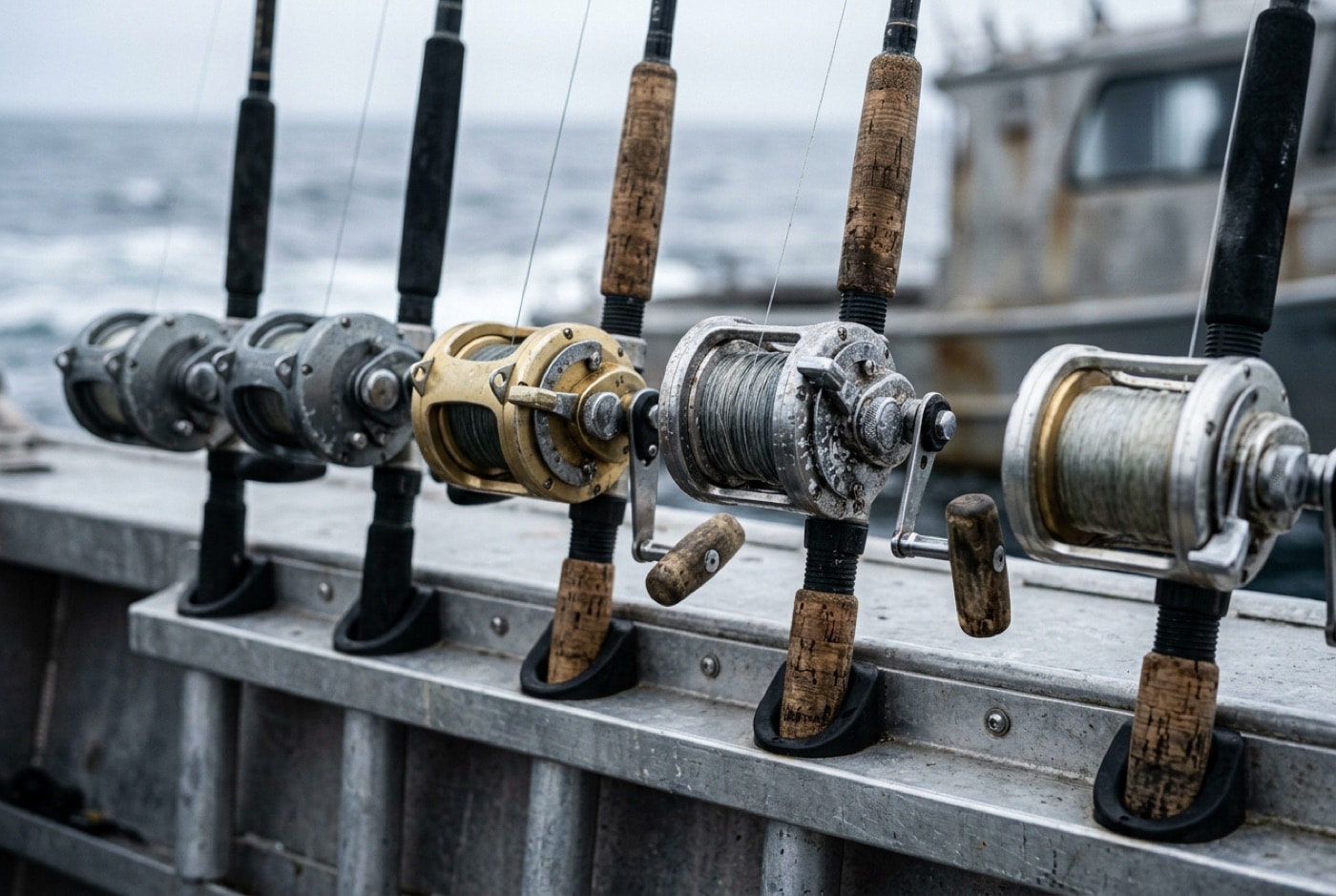
West Coast saltwater tackle developed in a specific direction because the fishing here has a specific shape: crowded rails, live bait, strong fish in relatively shallow water near structure, and a jig tradition that is largely regional. This page is a category-level reference. No brands are named and nothing is recommended — the intent is to explain what each class of gear is for, so a report that mentions it makes sense.
Conventional Reels
The dominant reel type on this coast, and the reason West Coast tackle looks unfamiliar to anglers from elsewhere. A conventional (overhead) reel with a strong drag and a narrow spool suits standing-rail fishing where line must be recovered fast and pressure applied directly. Sizes range from small bait reels holding light line for finicky surface fishing, through mid-size workhorses that cover most of the fishery, up to heavy two-speed reels built for extended fights on long range fishing.
Two-speed gearing matters more here than in most fisheries. A low gear gives the leverage to lift a large fish vertically out of deep water; a high gear recovers slack fast when a fish runs at the boat. On heavy tackle the ability to switch mid-fight is genuinely functional rather than a luxury.
Spinning Tackle
Historically a minority choice here, and increasingly common. Spinning gear handles light line and small baits well, casts further with less practice, and suits surface fishing for smaller grades. It is at a disadvantage under sustained heavy drag, which is why the heavy end of the fishery remains conventional.
Rods
Rod selection on this coast is described by line rating and action rather than by length alone. Live bait rods are relatively soft in the tip so a small bait can be cast without being torn off, with power low in the blank for lifting. Jig sticks are long, stiff and built to throw heavy surface iron a long way and drive a hook at distance. Heavy rail rods are short, powerful and designed to be braced against a boat rail with a fish pulling straight down.
Line
Monofilament remains standard for much of the bait fishing because of its stretch, which forgives a great deal on a crowded rail. Fluorocarbon leaders are near-universal where water is clear and fish are wary. Braided line, with almost no stretch and a much thinner diameter for a given strength, dominates deep applications where feel and line capacity matter. Most anglers carry all three in different combinations rather than committing to one.
Iron
Jigs — "iron" in local usage — are a defining feature of this fishery and split into two families.
- Surface iron is a long, light, flat jig thrown a long distance and retrieved steadily near the surface, principally for yellowtail and calico bass around kelp and structure. Throwing it well is a specific skill and the reason jig sticks exist.
- Yo-yo iron is a heavy, narrow jig dropped to depth and cranked back vertically at speed. It is a deep-water presentation for fish holding down on structure or under bait schools, and it is physically demanding to fish properly.
Bait Presentation
Most of the local fishery runs on live bait, and the presentations are few but exacting. A fly-lined bait carries no weight at all and swims naturally at the surface — the default when fish are up and feeding. A sinker rig adds just enough weight to reach fish holding below the surface layer. A dropper loop suspends a bait a fixed distance above a weight on the bottom, which is the standard approach for structure-holding species. Hook size is matched to bait size rather than to fish size, which is the single most common mistake visiting anglers make.
Terminal Tackle and Trolling
Circle hooks are widely used and in some fisheries required, because they hook in the jaw hinge and improve release survival. Ringed and open-eye hooks, swivels, crimps and heavy leader material make up the rest of the offshore kit. For wahoo and other high-speed pelagics, trolled lures with wire or heavy fluorocarbon leaders are standard, since anything lighter is bitten off immediately.
Gear Rules Are Regulated
Hook type, number of hooks, gear configuration and retrieval methods are all subject to regulation, and the rules differ by fishery and by area — circle hook requirements and barbless requirements in particular vary. This page describes what gear is for, not what is currently legal where you intend to fish. Check the CDFW ocean fishing regulations before rigging. The broader structure of the tackle trade on this coast is outlined under the sportfishing trade.
Note. An independent reference. Not affiliated with, endorsed by or connected to the AllCoast fishing community at allcoast.com, nor with any landing, sport boat, tackle company or publication described here. Nothing on this site is bookable, purchasable or joinable, and nothing here is regulatory, safety or navigational guidance.